


Cover Glass Thickness Design for Satellite Solar Cells
Design Optimization of Cover Glass for Strength, Optical Performance, and Environmental Resistance
In recent years, satellites and space equipment have increasingly pursued system-wide weight reduction and higher efficiency to reduce launch costs and improve power-generation performance. Within this trend, cover glass used to protect solar cell panels is also facing growing demands for thinner glass (0.05–0.2 mm) and larger panel sizes.
However, while thinner cover glass contributes to weight reduction and improved optical performance, it also tends to make manufacturing processes more susceptible to issues such as cracking, chipping, and warpage, which can affect process stability. In addition, for satellite solar cell applications, the glass must withstand severe environmental conditions, including vibration and shock during launch, as well as ultraviolet exposure and thermal cycling in orbit.
For this reason, when designing cover glass for satellite solar cells, it is essential to clarify the key criteria of thickness design at the early stage of development—including how thin the glass can be made and how to balance strength, optical performance, and environmental resistance.
This article organizes the fundamental concepts of thickness design for cover glass used in satellite solar cells and explains the key considerations during the design evaluation process.
Explore EG-S1: Ultra-Thin Cover Glass Designed for Space Applications

EG-S1 is designed to balance high optical transmittance, mechanical strength, and environmental resistance required for space use.
View EG-S1 Details →
- Relationship Between Thickness and Mechanical Strength
- Relationship Between Thickness and Optical Performance
- Material Selection with Consideration of UV and Radiation Environments
- Thermal Cycling and Structural Reliability
- Considerations When Designing Thin Cover Glass
- Considerations for Large-Area and Special-Shape Designs

01/Effects of Cover Glass Thickness on Fundamental Performance
Relationship Between Thickness and Mechanical Strength
Reducing the thickness of cover glass offers advantages such as weight reduction and improved flexibility. However, thinner glass also increases the risk of cracking, chipping, and warpage. With thin glass, in particular, failures are often initiated not by the external force itself but by edge quality, which frequently becomes the starting point of fracture.
The most critical factor here is the quality of edge finishing—meaning that the absence of microcracks is the highest priority condition. If microscopic cracks remain on the edges, they act as stress concentration points, and fracture can occur, regardless of glass thickness.
Therefore, if the edge finishing is insufficient, increasing the thickness does not fundamentally improve edge strength. The first requirement is to ensure the integrity of the glass edges; only after that can thickness design effectively contribute to overall strength.
In other words, the strength of glass is not determined simply by whether it is thin or thick. Instead, it is influenced by multiple factors, including:
• Quality of edge finishing (presence or absence of microcracks)
• External factors, such as scratches generated during handling
• Glass structure and material properties
When considering thickness design, it is essential to evaluate the reliability of the entire structure, taking all of these factors into account.
Relationship Between Thickness and Optical Performance
For cover glass used in solar cell applications, optical performance is also a critical design factor. In general, as the glass thickness increases, transmittance tends to decrease due to internal absorption. Therefore, thinner glass can be an effective approach for increasing the amount of incident light reaching the solar cells.
However, optical performance is not determined by thickness alone. It is important to evaluate it in combination with surface treatments, such as anti-reflection (AR) coatings that reduce surface reflection, as well as the intrinsic properties of the glass material itself. Thickness design should, therefore, be regarded as one of several elements used to maximize overall optical performance.
02/Key Points for Thickness Design, Considering the Space Environment
Material Selection with Consideration of UV and Radiation Environments
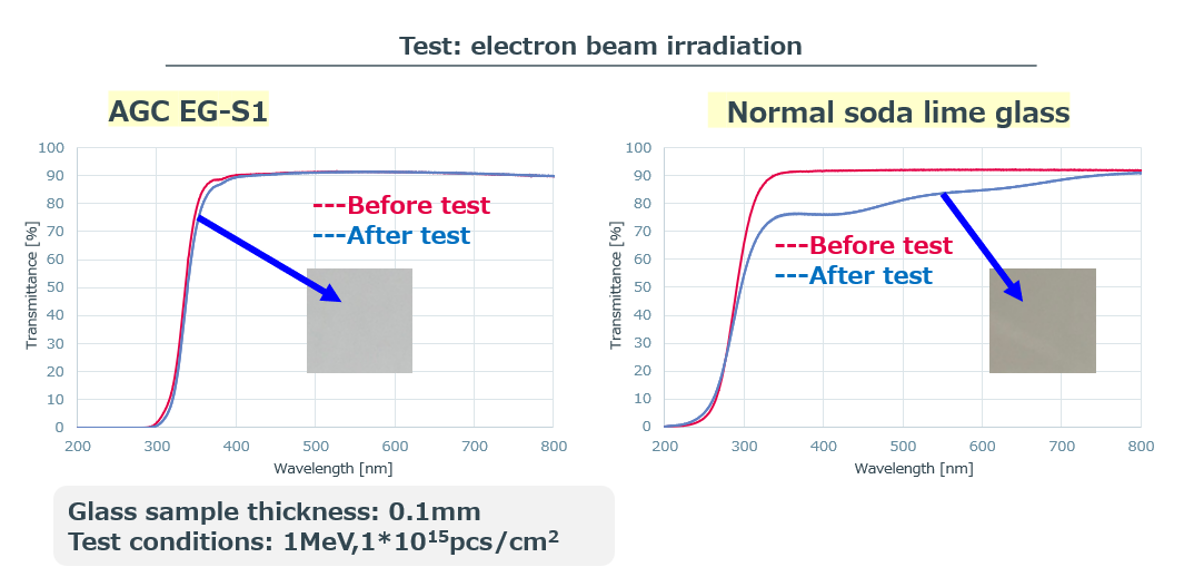
 In space, unlike on Earth, materials are exposed for long periods to intense ultraviolet radiation and high-energy particles, such as electron radiation. These environmental factors can affect the optical properties of glass materials, potentially causing reduced transmittance and color changes over time.
Therefore, when designing glass thickness, it is important to consider not only whether the glass should be thinner but also how the selected glass material behaves under space environmental conditions. Choosing glass materials with properties suited to space environments during the material selection stage is key to maintaining long-term performance.
In addition, when UV absorption or radiation shielding is required, a minimum thickness may be necessary. For applications exposed to particularly severe external environments over long durations, adopting a thicker glass design can be a rational approach—from the perspectives of shielding effectiveness and degradation suppression. Conversely, if the material properties are appropriate, sufficient radiation resistance may still be achieved with thin glass.
For example, in evaluations conducted by our company, 0.1 mm thick glass showed no change in characteristics under irradiation conditions of 1 MeV electron beams at a fluence of 1 × 10¹⁵/cm², demonstrating excellent resistance to space environmental exposure.
Thus, the relationship between thickness and environmental resistance is not simply proportional. Effective design decisions require a comprehensive evaluation that considers both material properties and experimental validation results.
Thermal Cycling and Structural Reliability
Cover glass used for satellite solar cells is repeatedly exposed to significant temperature fluctuations in orbit due to day–night cycles and other orbital conditions. These thermal cycles generate stress—not only in the cover glass itself but also across the entire structure, including the solar cell, backsheet, adhesive layers, and coatings. Differences in thermal expansion among these materials can lead to issues such as warpage or delamination.
Consequently, when designing the thickness of cover glass, it is important to consider the behavior of the system as a composite structure, rather than evaluating the glass alone. Thickness design should take into account the durability and reliability of the entire structure under repeated thermal cycling.
03/Perspectives for Practical Thickness Design Evaluation
Considerations When Designing Thin Cover Glass (0.05–0.2 mm)
Thin cover glass in the 0.05–0.2 mm range is an attractive option, from the perspectives of weight reduction and improved optical performance. However, reducing thickness also increases manufacturing and handling risks, so the benefits of thinner glass must be evaluated with these trade-offs.
When considering thin designs, it is effective to first clarify key requirements, such as:
• Required strength levels
• Expected space environmental conditions
• Optical performance requirements
Based on these factors, the glass thickness should be evaluated step-by-step, rather than determined all at once.
In addition, when producing mock-ups for practical evaluation, it is important to proceed with testing while gradually varying the cover glass thickness, allowing the design to be assessed through staged validation.
Considerations for Large-Area and Special-Shape Designs
As solar cell panels have increased in size in recent years, cover glass is required to accommodate larger surface areas and special geometries. Yet, complex, large-area shapes can lead to localized issues, such as warpage and stress concentration, making careful evaluation of thickness design particularly important.
At the early stage of design, it is advisable to organize the constraints related to size and shape and verify feasibility from the perspectives of materials and processing methods. Doing so helps reduce the risk of design changes in later stages of development. Moreover, selecting cover glass materials that allow flexibility in thickness and shape customization can further help mitigate design and manufacturing risks.

Explore EG-S1: Ultra-Thin Cover Glass Designed for Space Applications
EG-S1 is designed to balance high optical transmittance, mechanical strength, and environmental resistance required for space use.
View EG-S1 Details →04/Frequently Asked Questions in Design Considerations
Q. What is the most important point to consider when adopting thin cover glass?
The effects of thinning are not limited to mechanical strength. Multiple performance factors—including optical performance and environmental resistance—are interconnected.
Thus, at the early stage of design, it is important to clarify the priority of constraints, such as:
1. Whether the risks of fracture or delamination are acceptable (reliability constraints)
2. How much impact on power-generation efficiency can be tolerated (optical constraints)
3. To what extent degradation must be suppressed over the expected service life (environmental constraints)
A practical approach is to tentatively define the thickness range based on the most restrictive constraint and then optimize the balance with other performance requirements.
Q. Why does transmittance decrease in cover glass for solar cells?
Transmittance loss can arise from several factors. In design considerations, the most influential factors can generally be organized in the following order:
1. Surface reflection loss (Fresnel reflection)
Reflection inevitably occurs at the glass surface, resulting in a few percent loss from both surfaces combined. The presence or absence of AR coatings significantly affects transmittance.
2. Internal absorption within the glass (thickness-dependent)
As thickness increases, absorption losses within the glass also increase. This effect is particularly noticeable in the short-wavelength region, depending on the material properties.
3. Long-term degradation due to the space environment (UV and radiation)
Long-term exposure can gradually change the optical properties of the glass, resulting in reduced transmittance, making material selection critical.
Reduced transmittance is not determined by thickness alone. It depends on the combination of thickness, surface treatment, and material properties, so it is crucial to evaluate these factors comprehensively from the early design stage.
Q. What are the key points for thickness design that is resistant to thermal cycling?
To design cover glass that is resistant to thermal cycling, it is important to understand the stress-generation mechanisms within the entire composite structure, including adhesive layers and coating layers, rather than focus only on the heat resistance of the glass itself.
Three key points to note are:
1. Differences in coefficients of thermal expansion between materials
Different thermal expansion between dissimilar materials—such as the cover glass, cells, backsheet, adhesive layers, and coatings—generates cyclic stress, which becomes a starting point for warping and delamination.
2. Constraint conditions (fixation methods)
The stress distribution can change significantly, depending on whether the structure is edge-fixed or fully bonded. In some cases, constraint conditions dominate the behavior, even if the thickness is modified.
3. Reduced rigidity due to thinning
Thinner glass can increase deformation caused by temperature changes, potentially amplifying interlayer stresses.
Consequently, thickness should not be optimized in isolation. Instead, it should be determined by considering the overall balance of the system, including material combinations, bonding structures, and fixation conditions.
Q. When reviewing specifications based on past fractures or delamination, where should attention be focused?
If fractures or delamination have occurred in the past, it is important to first identify the origin of the failure and the stress-generation mechanism, rather than immediately change the thickness.
Key perspectives to examine include:
1. Location where fracture or delamination occurred
The dominant cause differs, depending on whether the failure originated from the edge, the central area, or an interface (adhesive or coating layer).
2. Identification of load conditions
It is necessary to determine whether the cause was launch shock, thermal cycling in orbit, or long-term degradation.
3. Constraint conditions and material combinations
If the main cause is related to fixation methods or differences in thermal expansion, simply changing the thickness may not fundamentally solve the problem.
Thickness is an important design variable, but re-evaluating the stress balance of the entire structure, rather than adjusting thickness alone, is essential for preventing recurrence.
05/EG-S1 as a Cover Glass Option for Satellite Solar Cells
As discussed in this article, cover glass for satellite solar cells must simultaneously satisfy multiple requirements, including thinness, edge strength, environmental resistance, and processing flexibility.
The EG-S1 cover glass for satellite solar cells provided by AGC offers several features that make it a viable material option during the design evaluation stage:
• Thin-glass capability, starting from 0.05 mm
• Compatibility with a wide range of thicknesses, from thin to thick glass
• Support for large-area and special-shape designs
• Material properties designed with the space environment in mind
• Surface treatment options, such as AR and ITO coatings
In addition, EG-S1 incorporates a special edge treatment that suppresses the formation of microcracks, ensuring high edge strength. This improves handling performance, helping reduce the risk of breakage during assembly processes and enabling further thinning in design.
EG-S1 is not simply a “thin-glass material.” It is a glass specifically designed for space applications, with edge quality, strength, and environmental resistance considered as an integrated system. As such, it can support a wide range of design requirements, from lightweight-oriented thin designs to high-durability thick-glass configurations.
06/Conclusion | Using Thickness Design as a Key Criterion for Material Selection
Thickness design for cover glass used in satellite solar cell applications is a critical factor in balancing mechanical strength, optical performance, and environmental resistance. By understanding material characteristics at the early stage of design and clearly defining the criteria for thickness selection, it becomes possible to reduce risks in later development and manufacturing stages.
When evaluating material properties and design options for cover glass for satellite solar cells, consulting with suppliers at an early stage can be a valuable approach.